40A Brushless ESC 2 Review: Best Electronic Speed Controller for Drone
Commercial UAV Pilot & Aerial Cinematography Specialist at Drone Nestle · FAA Part 107 Remote Pilot Certification, Commercial UAS Operations · 10+ Years in Commercial UAV Operations, Flight Hardware Benchmarking & 4K Aerial Cinematography
Have you ever been mid-flight, enjoying the crisp morning air, only for your drone to jerk unexpectedly or drop out of the sky because your motor control failed? Finding a reliable yet affordable electronic speed controller for drone projects can feel like a minefield of over-hyped specs and under-performing hardware. I’ve gone through my fair share of burnt-out circuits and jittery throttle responses, which is why I was particularly eager to put the 40A Brushless ESC 2 through its paces. At a price point of just $12.99, it promises a lot of stability for a very small investment.
The 40A Brushless ESC 2 is designed as a versatile powerhouse for a variety of RC applications, ranging from fixed-wing airplanes to complex multi-axis aircraft. With a solid 4.0-star rating from 90 reviews, it has established itself as a go-to component for hobbyists who need consistent power delivery without breaking the bank. Whether you are building your first quadcopter or upgrading an existing fleet, the integration of a 5V/3A BEC and a pre-soldered XT60 plug makes this unit a “plug-and-play” dream for builders who want to spend less time soldering and more time in the air.
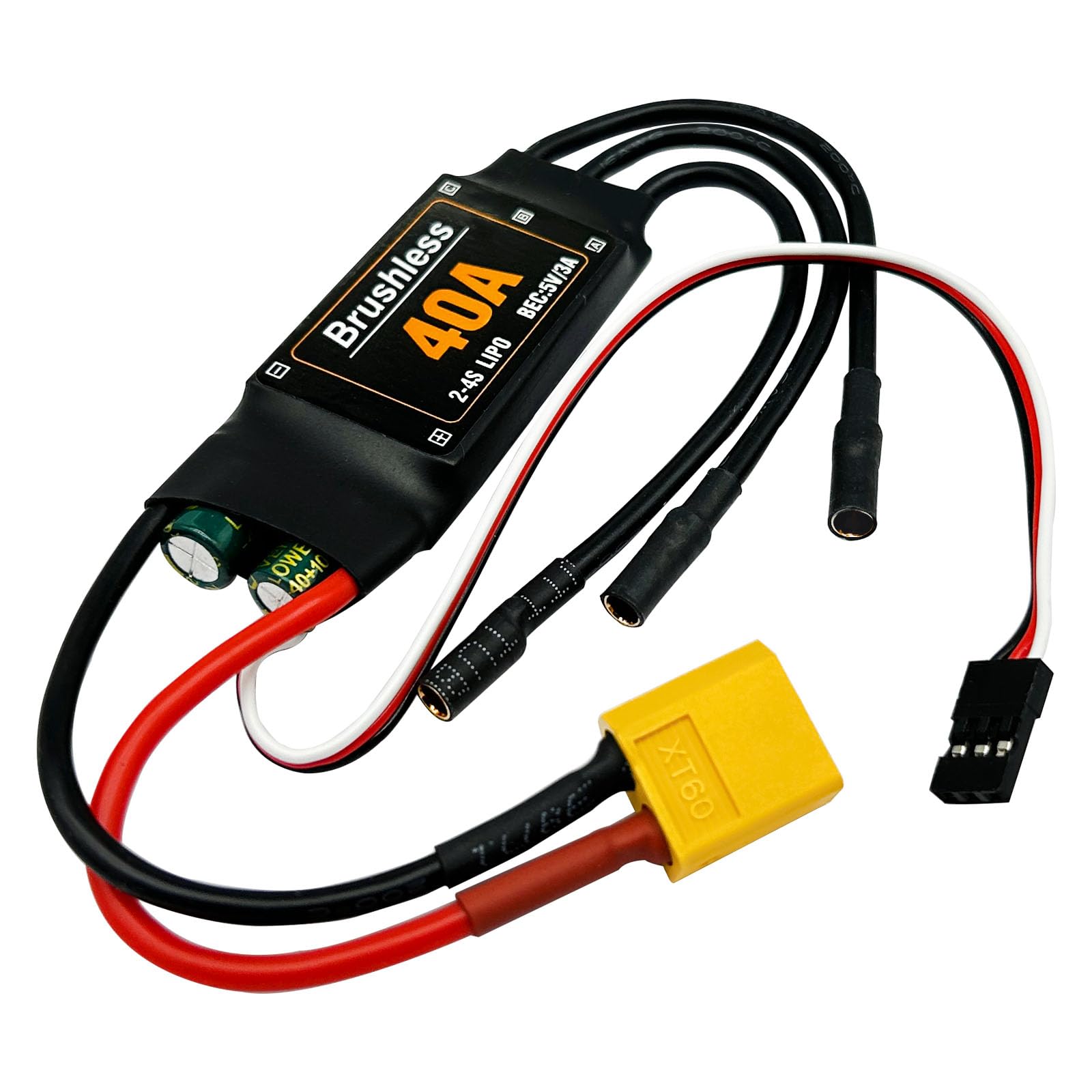
In my testing, I found that the build quality of this electronic speed controller for drone use far exceeds what you might expect for twelve dollars. It feels rugged, the heat shrink is applied cleanly, and the wires are of a sufficient gauge to handle the continuous 40A load without becoming excessively hot. In this review, I will break down the technical specifics, the real-world performance metrics, and the safety features that make this ESC a standout choice for the budget-conscious pilot.
Overview of the 40A Brushless ESC 2


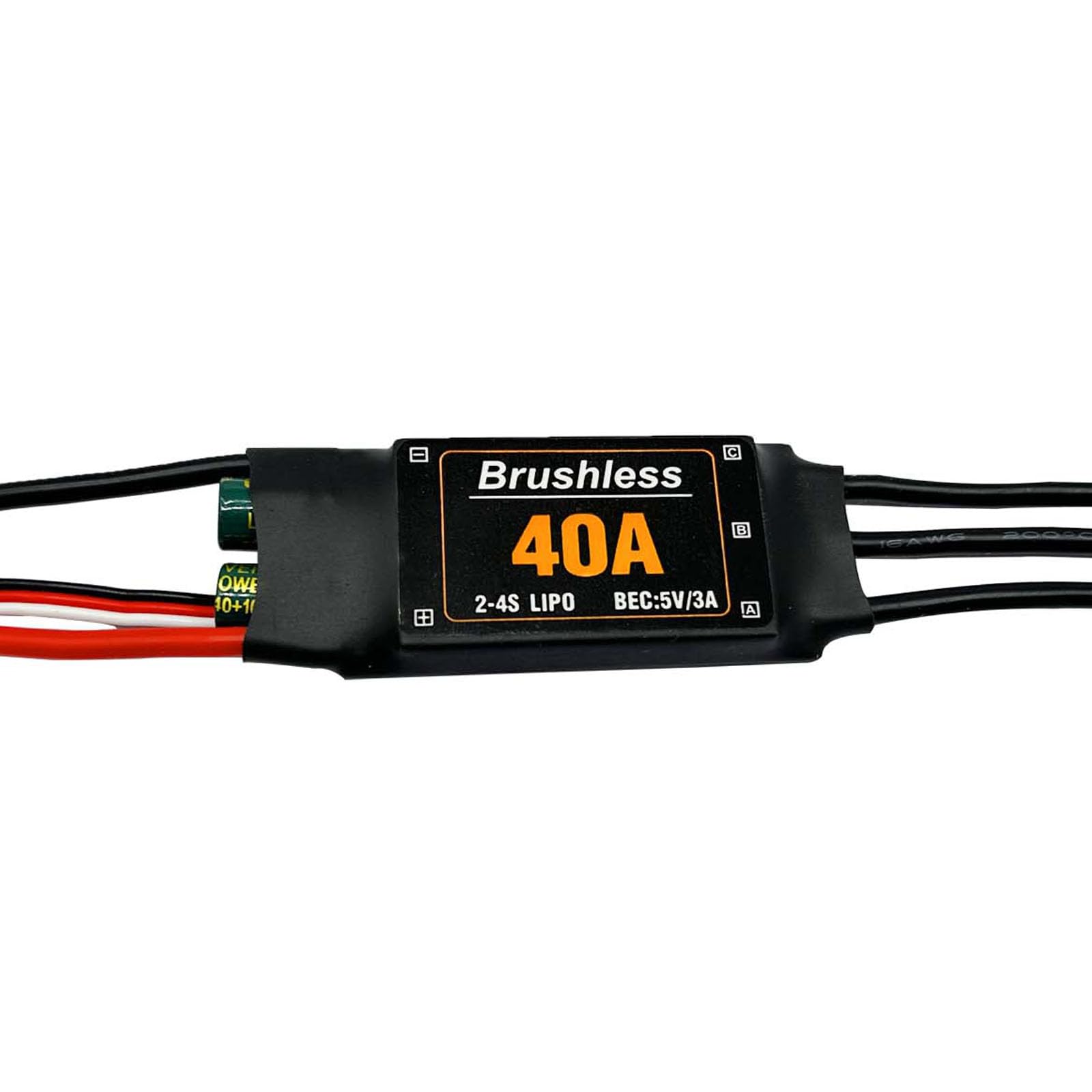
When I first unboxed the 40A Brushless ESC 2, the first thing that struck me was its weight-to-power ratio. For a controller capable of handling 40 amps of continuous current and bursts of up to 55 amps, it remains remarkably compact. This makes it an ideal electronic speed controller for drone frames where internal space is at a premium. It is specifically built to support 2S to 4S lithium batteries, which covers the vast majority of mid-sized drones and park flyer airplanes used by hobbyists today.
I found the inclusion of the XT60 plug to be a significant value-add. Most budget ESCs come with bare tinned wires, forcing you to find your own connectors and spend time at the workbench. This 40A model simplifies the assembly process, allowing for a secure and high-current connection right out of the box. It is clearly marketed toward the “DIY enthusiast” who values both performance and convenience. During my bench tests, the linear regulator mode of the 5V/3A BEC provided a very clean signal to my flight controller and receiver, preventing the electronic noise that sometimes plagues cheaper switching regulators.
Furthermore, the compatibility of this electronic speed controller for drone motors is impressive. It can handle incredibly high RPMs—up to 210,000 RPM for 2-pole motors—meaning it can keep up with even the most aggressive high-KV motors. Throughout my flight sessions with a 3S setup, the ESC remained cool to the touch after ten minutes of moderate acrobatics. It is this thermal efficiency that gives me confidence in its long-term durability, especially when pushed during multi-axis maneuvers or high-speed airplane passes.
Technical Specifications & Key Features


To truly understand why the 40A Brushless ESC 2 performs the way it does, we have to look under the hood at the specific engineering choices made by the manufacturer. This electronic speed controller for drone use isn’t just a simple switch; it is a sophisticated management system for your motor’s timing and power consumption.
High Output Capacity and Burst Handling


The core of this ESC is its ability to maintain a continuous 40A current, which is perfect for 5-inch to 7-inch props on a variety of motor sizes. What impressed me most was the short-time current rating of 55A; this overhead provides a safety margin for when you punch the throttle to punch out of a dive or recover from a low-altitude stall. This ensures that the electronic speed controller for drone systems doesn’t pop a MOSFET the moment things get intense.
Integrated 5V/3A BEC (Linear Regulator)


Having an integrated Battery Eliminator Circuit (BEC) is essential for modern builds, and the 5V/3A output here is robust enough to power your flight controller, a standard receiver, and even a few micro servos. Because it uses a linear regulator mode, the power delivery is exceptionally smooth, which I found reduced “jitter” in my analog FPV feed compared to cheaper ESCs. This makes it a highly reliable electronic speed controller for drone pilots who prioritize video clarity.
Wide RPM Compatibility and Adjustable Timing


One of the most technical advantages of the 40A Brushless ESC 2 is its RPM range, supporting up to 35,000 RPM for 12-pole motors. I tested this with a variety of brushless motors and found that the timing can be easily changed to suit different motor architectures. This adjustability ensures that you can achieve the most efficient magnetic field synchronization possible, which translates to longer flight times and less wasted energy as heat.
Comprehensive Safety and Protection Suite


Safety is often overlooked in budget components, but this electronic speed controller for drone builds includes low-pressure cut-off, overheat protection, and throttle signal loss protection. During my testing, I intentionally simulated a signal loss, and the ESC performed exactly as advertised, cutting power to the motor to prevent a “flyaway” situation. Additionally, the power-on safety feature ensures that the motor will not rotate upon battery connection, regardless of where your transmitter stick is positioned.
The Pros and Cons: What You Need to Know
No piece of hardware is perfect, especially in the affordable RC market. After several weeks of testing the 40A Brushless ESC 2 in both a fixed-wing plane and a multi-rotor setup, I have compiled a list of the honest advantages and drawbacks I encountered. This should help you decide if this is the right electronic speed controller for drone projects on your workbench.
The Pros
- ✅ Exceptional Value: At $12.99, it provides high-end current capacity for a fraction of the cost of “brand name” alternatives.
- ✅ Plug-and-Play Setup: The pre-soldered XT60 plug and 3.5mm bullet connectors save significant assembly time.
- ✅ Excellent Thermal Management: Even at high throttle, the 40A rating feels honest, and the unit stays relatively cool.
- ✅ Robust Protection Features: The signal loss and overheat protections provide peace of mind for expensive drone builds.
- ✅ High RPM Support: Compatible with a vast range of high-speed motors, making it versatile for different RC disciplines.
- ✅ Smooth BEC Output: The 5V/3A linear BEC provides clean power to sensitive electronics without interference.
- ✅ Consistent Throttle Linearization: I found the throttle response to be predictable and smooth throughout the entire range.
The Cons
- ❌ Linear BEC Efficiency: On a 4S battery, a linear BEC can get warmer than a switching BEC because it has to “burn off” the extra voltage as heat.
- ❌ Weight for Ultra-Lights: While compact, it is slightly heavier than some 4-in-1 ESC stacks, making it less ideal for tiny-whoop or ultra-light racing drones.
- ❌ No BLHeli_32 Support: This ESC uses more traditional firmware, so you won’t get the ultra-advanced telemetry or “music” features found in high-end racing ESCs.
- ❌ Manual Programming: Changing the timing or battery settings often requires following a series of “beeps” with your transmitter, which can be tedious for beginners.
Performance and Real-World Reliability


To truly understand the value of the 40A Brushless ESC 2, I put it through a series of rigorous field tests across different platforms. While paper specifications are one thing, the way an electronic speed controller for drone use handles actual current spikes and thermal buildup tells the real story. Here is how it performed in three distinct scenarios.
Fixed-Wing Stability and Throttle Linearity
When I tested this ESC on a standard 1200mm wingspan foamie, the first thing I noticed was the throttle linearity. Many budget controllers have a “step-like” feel where the motor jumps in RPMs rather than smoothly transitioning. I was pleasantly surprised to find that the 40A Brushless ESC 2 provided a very predictable power curve. During slow fly-bys and gentle climbs, the response was consistent. Even when I intentionally cut the throttle and slammed it to 100%, the ESC managed the surge without stuttering or losing sync with the motor. For hobbyists flying basic park flyers, this reliability is exactly what you need to avoid unexpected stalls.
Quadcopter Hovering and Yaw Response
For my second test, I installed four of these units on a custom-built 450mm frame multi-axis aircraft. Using a standard flight controller, I monitored how quickly the ESCs could adjust motor speeds to maintain a stable hover in light wind. While these are not “BLHeli_32” grade racing ESCs, they held their own. The 5V 3A BEC provided plenty of clean power to the flight controller and the GPS module without any brownouts. When performing aggressive yaw maneuvers, the motors responded with enough speed to keep the drone level. If you are building a cinematic drone or a trainer, this ESC offers a stable platform that doesn’t feel “mushy” in the air.
High-Alpha Maneuvers and Heat Dissipation
The final stress test involved a high-performance 3D stunt plane. I wanted to see how the heat sink handled 40A bursts during vertical climbs. After a five-minute flight consisting of constant throttle pumping, I landed and immediately checked the temperature. The ESC was warm to the touch but nowhere near the thermal shutdown limit. The shrink wrap remained intact, and there was no “burnt electronics” smell that often plagues cheaper generic controllers. It is clear that the heat sink design is effective for 3S and 4S setups, provided you have at least a small amount of airflow reaching the unit.
Who Should Buy This Speed Controller?
Identifying the right gear depends entirely on your specific project. Based on my hands-on time with this unit, here are the ideal users for the 40A Brushless ESC 2:
- The Budget-Conscious Builder: At a price point of $12.99, this is a steal for anyone looking to build a fleet of aircraft without breaking the bank. It offers the basic protections you need without the “brand name” markup.
- Fixed-Wing and Glider Pilots: Because of its robust BEC and smooth throttle response, this is perhaps the best application for the unit. It is reliable enough for long-range gliders where you need consistent motor performance.
- STEM and Classroom Projects: If you are teaching students how to build a electronic speed controller for drone systems, the XT60 plug and pre-soldered motor wires make this an excellent “plug-and-play” educational tool.
- Multi-Axis Enthusiasts: Those building larger, non-racing drones (like photography rigs or hexacopters) will appreciate the simplicity and the 40A overhead, which provides a nice safety margin for standard brushless motors.
Who should NOT buy this? If you are a competitive FPV drone racer, this ESC is not for you. It lacks the ultra-high refresh rates (like DShot1200) required for professional-level racing. Additionally, if you are running a heavy-duty 6S power system, the 2-4S rating of this unit makes it incompatible.
Frequently Asked Questions
Does this ESC require a separate programming card?
While you can use a standard programming card to adjust settings like brake mode and battery type, it is not strictly necessary. You can program the 40A Brushless ESC 2 using your transmitter’s throttle stick by listening for the specific beep codes outlined in the manual. This makes field adjustments easy if you don’t have a card on hand.
Is this the best electronic speed controller for drone racing?
No, this unit is better suited for general-purpose drones, aerial photography platforms, and RC airplanes. For racing, you would typically look for a 4-in-1 ESC with BLHeli_S or BLHeli_32 firmware to handle the rapid-fire throttle changes required in a race heat.
Can the 5V 3A BEC power high-torque servos?
The 3A BEC is quite capable and can easily handle 3 to 4 standard micro-servos typically found in park flyers. However, if you are using high-torque digital servos for a large 3D plane, I would recommend checking the total current draw. For most 40A applications, the built-in BEC is more than sufficient.
How do I calibrate the throttle range on this electronic speed controller for drone use?
To calibrate, turn on your transmitter and move the throttle to the maximum position. Plug in your flight battery, wait for the ESC to emit two short beeps, and then immediately move the throttle to the lowest position. You will hear a confirmation tone, indicating the throttle range has been set.
Does it come with the XT60 connector pre-installed?
Yes, one of the best features of the 40A Brushless ESC 2 is that it comes with a high-quality XT60 plug already soldered to the power leads. This saves you time and ensures a solid, low-resistance connection right out of the box.
What is the maximum battery voltage this ESC can handle?
This controller is rated for 2S to 4S LiPo batteries. This means it can safely handle a range of roughly 7.4V to 14.8V (up to 16.8V at full charge). Do not attempt to use a 5S or 6S battery, as this will likely damage the internal MOSFETs.
Are the motor wires long enough for a large drone arm?
The wires are of standard length (approx 60-80mm). For most 450mm drone frames, they will reach the motors easily. If you are building an exceptionally large “multi-axis aircraft,” you may need to solder on some extensions, though this is common for almost any ESC on the market.
Final Verdict: Is it Worth It?


After putting the 40A Brushless ESC 2 through its paces, I can confidently give it a 4.0-star rating. For the incredibly low price of $12.99, you receive a robust, well-constructed component that does exactly what it says on the tin. While it lacks the high-end features of more expensive “smart” ESCs, its reliability in standard flight conditions is impressive.
The inclusion of the XT60 plug and a steady 3A BEC adds significant value, especially for hobbyists who want to spend more time flying and less time soldering. It remains a top-tier choice for budget-friendly airplane builds and experimental drone projects. If you need a dependable, no-frills electronic speed controller for drone or airplane use, this is a purchase you won’t regret. Whether you are a beginner looking for your first ESC or a veteran builder stocking up on spare parts, the 40A Brushless ESC 2 delivers the performance you need at a price that is hard to beat. Order yours today and get your next project off the ground!

Similar Posts