Editorial disclosure: This comparison is based on DJI’s published specifications and support information, checked on June 9, 2026. DroneNestle has not independently laboratory-tested these two aircraft. Flight time, range, sensing performance, and image quality vary with conditions, settings, firmware, and local regulations.
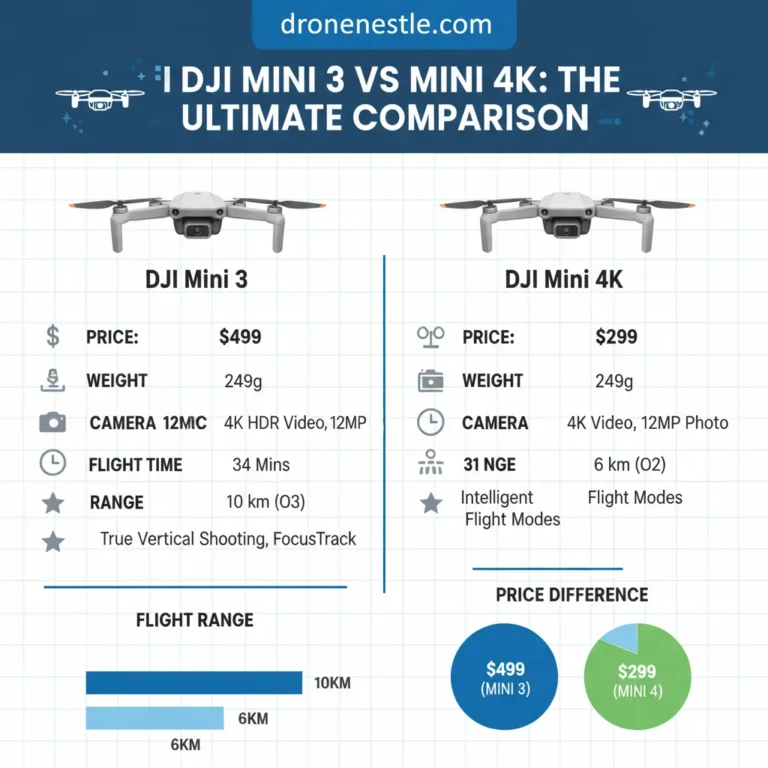
DJI Mini 3 and Mini 3 Pro share the same basic appeal: both are compact sub-249 g camera drones with a 1/1.3-inch sensor and true vertical shooting. Mini 3 favors battery life and simplicity, while Mini 3 Pro adds obstacle sensing, subject tracking, faster video modes, and more creative automation.
Key Specifications
| Feature | DJI Mini 3 | DJI Mini 3 Pro |
|---|---|---|
| Standard takeoff weight | 248 g | Under 249 g |
| Camera sensor | 1/1.3-inch CMOS, 48 MP | 1/1.3-inch CMOS, 48 MP |
| Lens | 24 mm equivalent, f/1.7 | 24 mm equivalent, f/1.7 |
| Maximum 4K frame rate | 30 fps | 60 fps |
| Color options | Normal | Normal and D-Cinelike |
| Obstacle sensing | Downward vision positioning | Forward, backward, and downward vision sensing |
| Subject tracking | No FocusTrack | FocusTrack with ActiveTrack, Spotlight, and Point of Interest |
| Transmission | DJI O2, up to 10 km FCC | DJI O3, up to 12 km FCC |
| Standard battery flight time | Up to 38 minutes | Up to 34 minutes |
| Plus battery flight time | Up to 51 minutes where available | Up to 47 minutes where available |
Camera and Video
The two cameras have similar core hardware. DJI specifies a 1/1.3-inch 48 MP sensor, a 24 mm-equivalent f/1.7 lens, RAW still capture, and a gimbal that rotates for true vertical shooting on both models.
Mini 3 records 4K video at up to 30 fps and uses DJI’s Normal color profile. Mini 3 Pro reaches 4K/60 fps, adds 1080p/120 fps slow motion, and provides D-Cinelike for users who want more flexibility during color correction. The Pro model is therefore the better fit for faster action and a more involved editing workflow.
Obstacle Sensing and Tracking
Mini 3 has a downward vision system for positioning but does not include forward or backward obstacle sensors. Mini 3 Pro adds forward, backward, and downward sensing, APAS 4.0, and FocusTrack. Those additions support automated subject tracking and more assistance around obstacles.
Obstacle sensing is an aid rather than a guarantee. Transparent surfaces, thin branches, low light, speed, and feature-specific limitations can reduce detection performance. Pilots remain responsible for maintaining visual awareness and following local flight rules.
Flight Time and Transmission
DJI rates Mini 3 for up to 38 minutes with its standard battery and up to 51 minutes with the Plus battery where available. Mini 3 Pro is rated for up to 34 and 47 minutes respectively. These are controlled manufacturer tests rather than typical guaranteed flight durations.
Mini 3 uses DJI O2 with a published maximum of 10 km under unobstructed FCC test conditions. Mini 3 Pro uses O3 with a published 12 km maximum under comparable FCC conditions. Neither figure represents a legal operating radius, and actual transmission distance can be much shorter.
Which Model Is the Better Buy?
Choose DJI Mini 3 if:
- You mainly shoot landscapes, travel, or casual aerial video.
- Longer published battery life matters more than tracking features.
- 4K/30 fps meets your needs.
- You can buy it at a meaningfully lower price.
Choose DJI Mini 3 Pro if:
- You need 4K/60 fps or 1080p slow motion.
- Forward and backward obstacle sensing are important to your flying.
- You plan to use ActiveTrack, Spotlight, Point of Interest, or MasterShots.
- D-Cinelike is useful in your editing workflow.
Verdict
Mini 3 is the value and endurance choice. Mini 3 Pro earns its name through sensing, tracking, faster video, and additional creative modes. For simple manual flying, Mini 3 is usually sufficient; for moving subjects and more advanced capture, Mini 3 Pro is the stronger tool.