Editorial disclosure: This is a specification-based comparison using DJI’s published product information, checked on June 9, 2026. DroneNestle did not conduct the laboratory tests cited by DJI and does not claim independent hands-on testing. Flight time, transmission range, and imaging performance vary with regulations, firmware, weather, settings, interference, and use.
DJI Mini 5 Pro is the stronger option for pilots who prioritize low-light imaging, flexible camera movement, and improved nighttime obstacle sensing. DJI Mini 4 Pro remains a capable alternative with 4K/60fps HDR video, omnidirectional obstacle sensing, and DJI’s O4 transmission system.
Key Differences
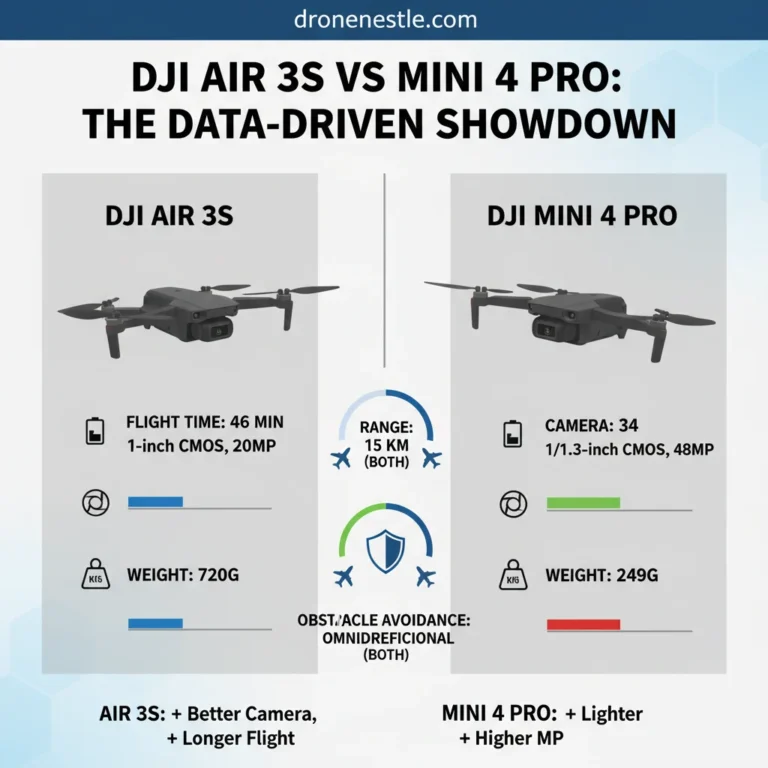
| Feature | DJI Mini 5 Pro | DJI Mini 4 Pro |
|---|---|---|
| Main sensor | 1-inch CMOS, 50 MP | 1/1.3-inch CMOS, 48 MP |
| Lens aperture | f/1.8 | f/1.7 |
| Published HDR dynamic range | Up to 14 stops | DJI does not publish the same 14-stop claim |
| Standard battery flight time | Up to 36 minutes | Up to 34 minutes |
| Plus battery flight time | Up to 52 minutes where available | Up to 45 minutes where available |
| Obstacle sensing | Omnidirectional sensing with forward LiDAR and low-light support | Omnidirectional binocular vision plus lower 3D infrared sensing |
| Gimbal movement | Up to 225-degree roll rotation | True vertical shooting at 90 degrees |
| Video transmission | O4+, up to 20 km under DJI’s FCC test conditions | O4, up to 20 km under DJI’s FCC test conditions |
| Internal storage | 42 GB | 2 GB |
| Weight/class | C0 in supported European markets with the standard battery | Under 249 g in the standard configuration; C0 in supported European markets |
Camera
Mini 5 Pro makes the larger imaging upgrade. DJI lists a 50 MP 1-inch CMOS sensor, an f/1.8 lens, and up to 14 stops of dynamic range for HDR video. A larger sensor provides more capture area than the 1/1.3-inch sensor in Mini 4 Pro, although final image quality still depends on exposure, processing, motion, and lighting.
Mini 4 Pro uses a 48 MP 1/1.3-inch CMOS sensor with an f/1.7 lens. DJI specifies 4K HDR video at up to 60 fps, 4K slow-motion video at up to 100 fps, and 10-bit D-Log M and HLG recording.
Mini 5 Pro also adds a 48 mm-equivalent medium-tele mode and a gimbal capable of up to 225 degrees of roll movement. That gives creators more framing options than Mini 4 Pro’s horizontal and true-vertical orientations.
Flight Time
DJI rates Mini 5 Pro for up to 36 minutes with its standard Intelligent Flight Battery and up to 52 minutes with the Plus battery where that battery is sold. DJI rates Mini 4 Pro for up to 34 minutes with its standard battery and up to 45 minutes with the Plus battery.
These figures are manufacturer results from controlled test conditions, not independent DroneNestle measurements. Wind, temperature, speed, camera use, return-to-home reserves, battery age, and local firmware settings can reduce usable flight time.
Obstacle Sensing and Return to Home
Mini 5 Pro adds forward-facing LiDAR and supports omnidirectional obstacle sensing in the low-light conditions specified by DJI. DJI also states that the aircraft can memorize flight routes in sufficient light, supporting visual-positioning-based return behavior when satellite reception is unavailable.
Mini 4 Pro provides omnidirectional binocular vision sensing and a lower 3D infrared sensor. Its sensing system requires adequate light and patterned surfaces, so it should not be described as guaranteed collision prevention.
Neither system replaces visual observation, legal line-of-sight requirements, or conservative flight planning.
Transmission
Mini 5 Pro uses DJI O4+ and Mini 4 Pro uses DJI O4. DJI publishes a maximum 20 km transmission distance for both under unobstructed FCC test conditions. This number is not a safe or legal operating radius. Actual range can be much shorter around buildings, trees, Wi-Fi networks, terrain, or regulatory power limits.
Which One Should You Buy?
Choose Mini 5 Pro when:
- Low-light image quality is a primary concern.
- You want the 1-inch sensor and 225-degree gimbal roll.
- Forward LiDAR and improved nighttime sensing matter to your workflow.
- The longer published battery options justify the higher purchase price.
Choose Mini 4 Pro when:
- Its current selling price is more important than having the newest camera hardware.
- 4K/60fps HDR, 10-bit D-Log M, and omnidirectional sensing meet your needs.
- You already own Mini 4 Pro-compatible batteries, controllers, or accessories.
- You prefer a mature platform with established accessories and documentation.
Verdict
Mini 5 Pro is the more capable camera drone on DJI’s published specifications, particularly for sensor size, gimbal flexibility, low-light sensing, and battery options. Mini 4 Pro remains practical for pilots who do not need those upgrades and can buy it at a meaningful discount.
Base the decision on price, local regulations, compatible accessories, and features you will actually use, not on undocumented “real-world” percentages or invented flight tests.