Editorial disclosure: This comparison uses DJI’s official specifications and product information, checked on June 9, 2026. DroneNestle has not independently laboratory-tested either drone. Published flight time, range, dynamic range, and sensing figures are manufacturer results under specified conditions.
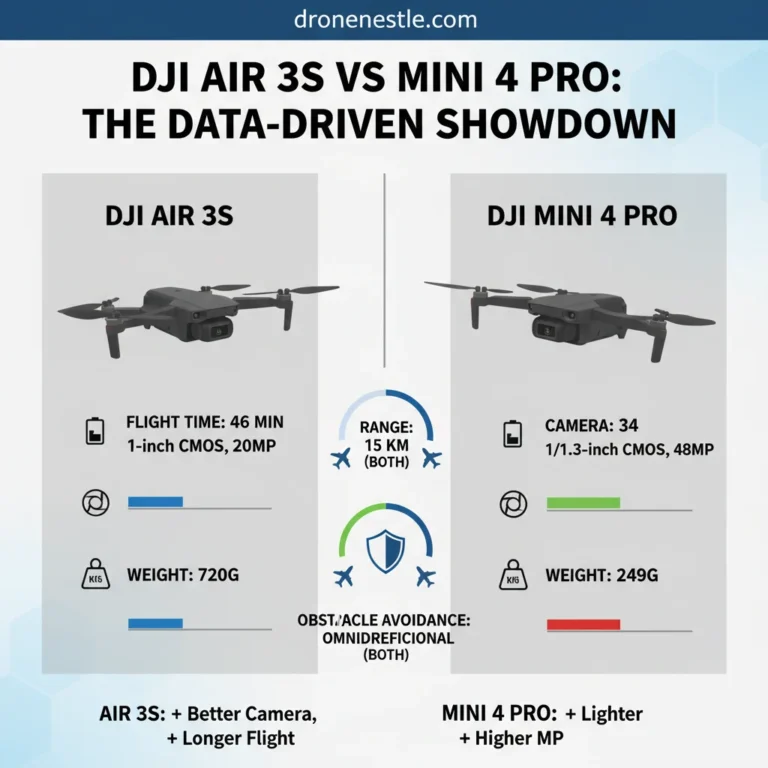
DJI Air 3S is an imaging and low-light-sensing upgrade over Air 3, not a complete redesign. Both are dual-camera travel drones with 24 mm wide and 70 mm medium-tele perspectives, O4 transmission, omnidirectional sensing, and roughly 45 minutes of published flight time. Air 3 remains competitive when its lower price matters more than the Air 3S’s larger main sensor.
Key Specifications
| Feature | DJI Air 3 | DJI Air 3S |
|---|---|---|
| Takeoff weight | 720 g | 724 g |
| Wide camera | 1/1.3-inch CMOS, 48 MP, 24 mm, f/1.7 | 1-inch CMOS, 50 MP, 24 mm, f/1.8 |
| Medium tele camera | 1/1.3-inch CMOS, 48 MP, 70 mm, f/2.8 | 1/1.3-inch CMOS, 48 MP, 70 mm, f/2.8 |
| HDR video | Up to 4K/60 fps | Up to 4K/60 fps |
| Higher-frame-rate video | Up to 4K/100 fps | Up to 4K/120 fps on the main camera |
| Published HDR dynamic range | DJI does not publish the same 14-stop claim | Up to 14 stops |
| Obstacle sensing | Omnidirectional binocular vision plus lower infrared sensing | Omnidirectional binocular vision, forward LiDAR, and lower infrared sensing |
| Maximum flight time | Up to 46 minutes | Up to 45 minutes |
| Transmission | O4, up to 20 km FCC | O4, up to 20 km FCC |
| Internal storage | 8 GB | 42 GB |
Camera Upgrade
Air 3 uses two 1/1.3-inch 48 MP sensors. That gives its wide and medium-tele cameras closely matched core hardware and supports 4K/60 fps HDR, 4K/100 fps recording, 10-bit D-Log M, and 10-bit HLG.
Air 3S keeps a 1/1.3-inch 48 MP sensor behind the 70 mm lens but enlarges the 24 mm main camera to a 1-inch 50 MP sensor. DJI also publishes up to 14 stops of dynamic range and 4K/120 fps capability for the main camera. The larger wide sensor is the primary reason to choose Air 3S for landscapes, interiors, sunsets, and other demanding light.
Obstacle Sensing and Return to Home
Both provide omnidirectional binocular vision sensing. Air 3S adds forward-facing LiDAR and DJI’s nightscape obstacle-sensing system, with a lower published light requirement for its vision sensors. DJI also promotes a newer Smart Return to Home system on Air 3S.
These systems assist a pilot but do not guarantee obstacle detection. Thin branches, wires, transparent surfaces, poor texture, weather, speed, and lighting can limit performance.
Flight Time, Storage, and Transmission
Air 3 has a small paper advantage in maximum flight time: DJI lists 46 minutes, compared with 45 minutes for Air 3S. Different official test conditions apply, and neither figure represents a normal guaranteed mission duration.
Both use O4 with a 20 km FCC laboratory maximum in unobstructed conditions. Air 3S increases internal storage from 8 GB to 42 GB, which is useful when a microSD card is missing or full.
Which One Should You Buy?
Choose Air 3 if:
- You can buy it at a substantial discount.
- Two matched 1/1.3-inch cameras meet your needs.
- 4K/100 fps is sufficient.
- You mainly fly in daylight and do not need LiDAR-assisted night sensing.
Choose Air 3S if:
- The 1-inch primary camera is important for your work.
- You shoot high-contrast or lower-light scenes.
- Forward LiDAR and newer nighttime return features are valuable.
- 42 GB of internal storage and 4K/120 fps justify the price difference.
Verdict
Air 3S is the stronger imaging platform, mainly because of its 1-inch wide camera and upgraded low-light sensing. Air 3 remains a capable value option with nearly the same endurance, the same two focal lengths, and the same published O4 range. Existing Air 3 owners should upgrade for the camera and sensing changes, not for flight time.