Editorial disclosure: This specification-based comparison uses DJI’s official product information, checked on June 9, 2026. DroneNestle has not independently laboratory-tested these aircraft. Flight time, transmission distance, sensing, and camera performance vary with conditions, firmware, settings, and local regulations.
DJI Air 3 and Mini 4 Pro share modern DJI features such as O4 transmission, omnidirectional sensing, 4K/60 fps HDR, 10-bit color modes, and automated tracking. The decision is mainly between Air 3’s dual-camera system and longer endurance versus Mini 4 Pro’s sub-249 g portability and true vertical capture.
Key Specifications
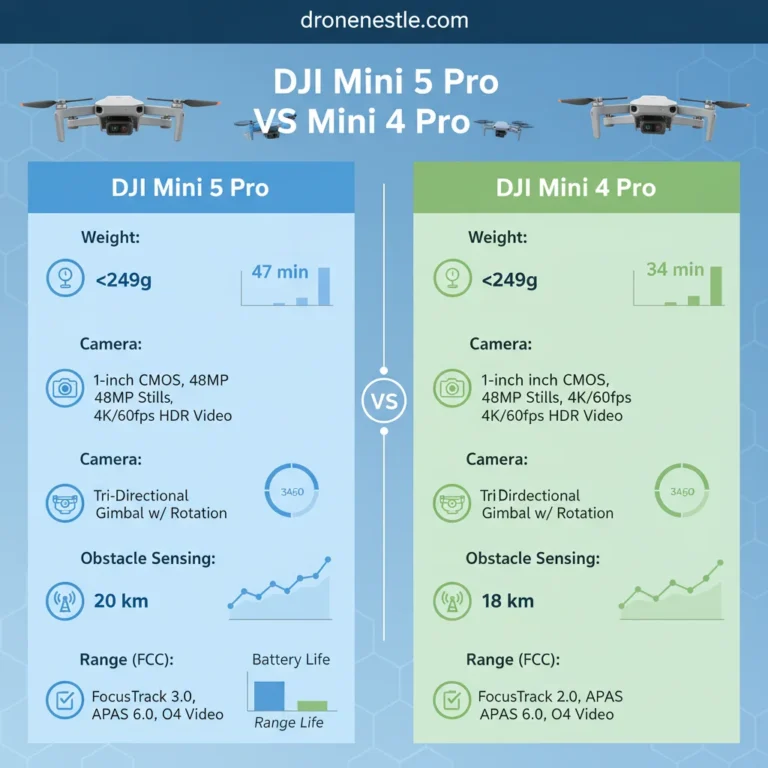
| Feature | DJI Air 3 | DJI Mini 4 Pro |
|---|---|---|
| Takeoff weight | 720 g | Under 249 g standard configuration |
| Wide camera | 1/1.3-inch CMOS, 48 MP, 24 mm, f/1.7 | 1/1.3-inch CMOS, 48 MP, 24 mm, f/1.7 |
| Second camera | 1/1.3-inch CMOS, 48 MP, 70 mm, f/2.8 | None |
| Video | 4K/60 fps HDR; up to 4K/100 fps | 4K/60 fps HDR; up to 4K/100 fps |
| Color | 10-bit D-Log M and HLG | 10-bit D-Log M and HLG |
| Vertical capture | Vertical recording modes with a crop | True vertical shooting with rotating gimbal |
| Maximum flight time | Up to 46 minutes | Up to 34 minutes standard; 45 minutes Plus where available |
| Obstacle sensing | Omnidirectional binocular vision plus lower infrared | Omnidirectional binocular vision plus lower 3D infrared |
| Transmission | O4, up to 20 km FCC | O4, up to 20 km FCC |
| Internal storage | 8 GB | 2 GB |
Camera Differences
The 24 mm wide cameras are closely matched on paper: both use a 1/1.3-inch 48 MP sensor and an f/1.7 lens, and both support 4K/60 fps HDR, 4K/100 fps, 10-bit D-Log M, and HLG.
Air 3 adds a separate 70 mm-equivalent 3x medium-tele camera. That focal length changes perspective and subject separation without depending on digital enlargement. Mini 4 Pro has only the wide camera, but its gimbal rotates for true vertical capture without cropping a horizontal frame.
Size, Weight, and Flight Time
Mini 4 Pro’s standard configuration stays under 249 g, making it much easier to carry and potentially reducing requirements in some jurisdictions. Air 3 weighs 720 g and needs a larger case, but its bigger battery supports a DJI-rated 46-minute maximum.
Mini 4 Pro is rated for 34 minutes with the standard battery and 45 minutes with the Plus battery where sold. The Plus option takes it above 249 g, so pilots should reassess the applicable rules before using it.
Sensing and Transmission
Both offer omnidirectional binocular vision sensing and O4 transmission. DJI publishes a 20 km FCC maximum for each under unobstructed, interference-free test conditions. This does not override visual-line-of-sight rules or provide a guaranteed real operating range.
Vision sensing depends on adequate light, visible surface texture, speed, and the type of obstacle. Neither model should be treated as collision-proof.
Which One Should You Buy?
Choose Air 3 if:
- The 70 mm medium-tele camera is central to your photography.
- You want longer standard-battery endurance.
- A larger aircraft is acceptable for your travel and regulatory situation.
- You value a dual-camera system more than native vertical capture.
Choose Mini 4 Pro if:
- Sub-249 g portability is the deciding factor.
- You need true vertical shooting.
- The 24 mm-equivalent camera covers your work.
- You want a smaller and generally lower-cost kit.
Verdict
Air 3 is the more versatile photography tool because of its second camera and longer endurance. Mini 4 Pro delivers much of the wide-camera and flight technology in a far lighter package. Choose based on the 70 mm camera and weight class, because their wide-camera specifications and O4 transmission are otherwise closely aligned.