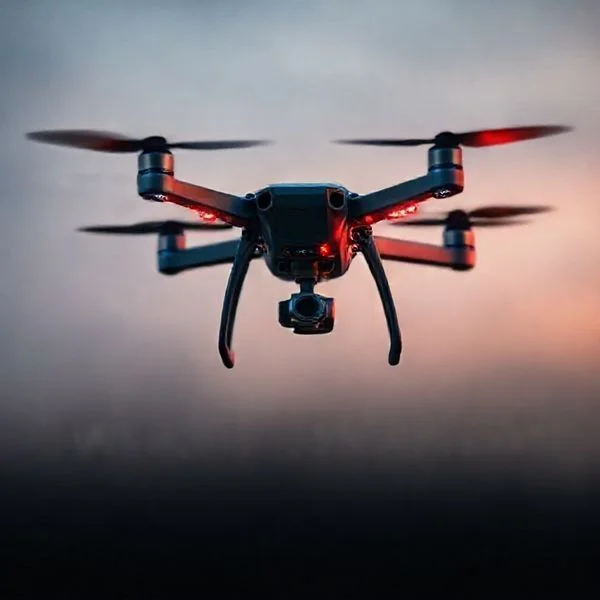
At night, a police drone is most easily identified by its combination of bright FAA-mandated white/green strobes and agency-specific flashing red and blue lights. Unlike stars or planes, these drones exhibit unique hovering capabilities and emit a distinct high-pitched buzzing sound that carries in quiet environments.
🎯 Key Takeaways
- Identify drones by flashing red and blue lights used during active police operations.
- Look for high-intensity white or green strobes visible from three miles away.
- Drones hover in fixed spots for long periods, unlike planes or satellites.
- Listen for a consistent high-pitched buzzing or ‘beehive’ sound at low altitudes.
- Watch for rapid, non-linear directional changes that commercial aircraft cannot perform.
Identifying a police drone at night comes down to three specific visual cues: high-intensity strobe patterns, the presence of red and blue flashing LEDs, and erratic, non-linear movement. Unlike airplanes or stars, police drones typically operate at low altitudes and maintain a “stuttering” light signature designed for visibility and safety. Knowing what to look for allows you to quickly distinguish a law enforcement tool from a hobbyist drone or a distant star.
Prime for Young Adults — 6 Months Free
Exclusive Offer Amazon Prime for Young Adults, Students and 18–24s get six months of Prime free, then half price.
Start 6 Months Free As an Amazon Associate I earn from qualifying purchases.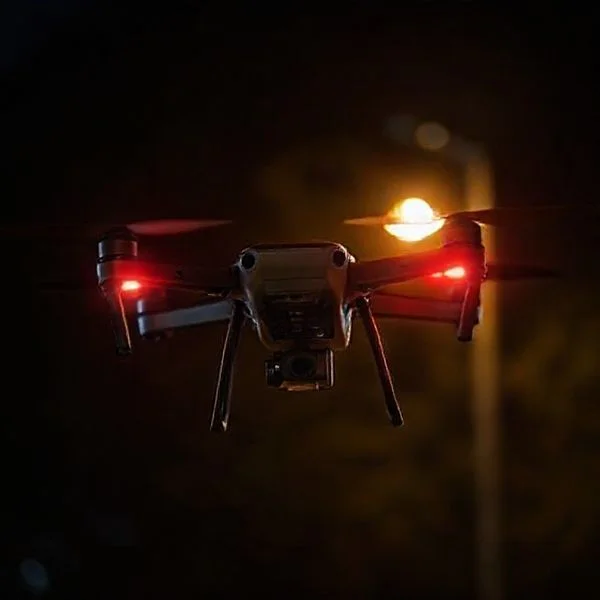
This identification is practically important for your situational awareness. Whether you are curious about local surveillance or simply trying to identify a strange light in the sky, understanding the specific lighting and movement protocols used by agencies ensures you aren’t guessing. In most jurisdictions, these drones must remain visible to other aircraft, which makes them surprisingly easy to spot if you know the FAA lighting standards and agency-specific hardware.
Decoding Light Signatures: FAA Strobes vs. Police Red and Blues
Recommended Best Deal Products



The most immediate way to identify a police drone is by its “lighting kit.” Under FAA Part 107 regulations, any drone flown at night for professional purposes must be equipped with anti-collision lighting visible for at least three statute miles. While hobbyists might use small, dim lights, police agencies utilize high-lumen strobes that are much brighter than the drone’s standard navigation lights.
The High-Intensity Anti-Collision Strobe
The primary light you will see is a rapid, high-intensity strobe. This is not a solid glow but a sharp, repetitive pulse. Most law enforcement agencies, such as those using the DJI Matrice 300 or Autel EVO series, mount these on the top or bottom of the craft to prevent mid-air collisions. Unlike the steady blinking of an airplane, these strobes are designed to be “obnoxious” and impossible to miss.
- Flash Rate: Expect between 40 and 100 flashes per minute, creating a rhythmic pulsing effect.
- Colors: Typically white or green. White is most common for maximum distance, while green is often used by operators to distinguish their drone from white stars or red tower lights.
- Intensity: These lights are powerful enough to be seen from miles away, appearing as a sharp “twinkle” that is much more aggressive than a star’s shimmer.
The “Red and Blue” Agency Signature
Unlike standard commercial drones, many police units are outfitted with auxiliary “emergency” lighting modules. These are often secondary attachments designed to mimic the appearance of a patrol car. If you see alternating red and blue flashes alongside a white strobe, you are looking at a law enforcement or first responder aircraft. These lights serve as a visual deterrent and a way to signal ground units during a pursuit or search operation.
- Positioning: These lights are usually mounted on the landing gear or the front arms of the drone.
- Purpose: They are rarely used for “stealth” missions; instead, they are turned on when the police want a visible presence to warn people in the area.
Distinguishing Flight Patterns: How Drones Move Differently Than Planes
If the lights don’t give it away, the movement certainly will. Airplanes and helicopters must follow physics that require wide turns and constant forward momentum. Police drones, powered by multi-rotor systems, move with a “robotic” precision that is distinct from any manned aircraft. When you watch a drone, you will notice it defies the typical “path” you expect from a flying object.
The Static Hover and “Orbit” Maneuver
The biggest giveaway is the drone’s ability to stay perfectly still. If you see a bright light that hangs in the air for minutes without drifting, it is likely a drone in a “hover” state, likely monitoring a specific scene. Police drones often use an “orbit” mode where they circle a fixed point on the ground while keeping their thermal camera centered on a target.
- Fixed Hover: The drone remains at a specific GPS coordinate, appearing like a very low, very bright star that refuses to move with the celestial sphere.
- Tight Circling: They can circle a single building or intersection with a radius of only 50 to 100 feet—something no helicopter can safely do at night.
- Low Altitude: Most police drones fly between 150 and 400 feet, making them appear much larger and faster across your field of vision than high-altitude planes.
Rapid Directional and Altitude Changes
Drones can stop, reverse, or change altitude almost instantly. Watch for “stair-step” movements where the drone drops 50 feet in a second and then stops dead. They can also perform 90-degree turns without banking or slowing down. This jerky, mechanical movement is a clear indicator that the object is a drone rather than a traditional aircraft. If the light source suddenly zips vertically upward or dives toward the tree line at high speed, you are likely watching a drone operator adjusting their vantage point.
Prime for Young Adults — 6 Months Free
Exclusive Offer Amazon Prime for Young Adults, Students and 18–24s get six months of Prime free, then half price.
Start 6 Months Free As an Amazon Associate I earn from qualifying purchases.The Auditory Profile: Identifying the Unique Drone Hum at Night
Recommended Best Deal Products


When visibility is low, your ears often become your primary tool for detecting a police drone. Unlike consumer-grade hobbyist drones, law enforcement typically utilizes enterprise-level aircraft. These larger machines move a significant volume of air, creating a distinct acoustic signature that sounds very different from a small toy drone.
The “Angry Bee” vs. The Heavy Thrum
Most small drones produce a high-pitched, buzzing sound frequently compared to a swarm of angry bees. However, police drones like the DJI Matrice 300 RTK or the Autel EVO II Dual 640T are heavier and require larger propellers. This results in a deeper, more rhythmic “thrumming” sound. At night, when ambient city noise dies down, this low-frequency vibration can carry for several blocks.
- Frequency Shifts: If the pitch suddenly rises, the drone is likely ascending or accelerating. A steady, consistent hum usually indicates a stationary hover for surveillance.
- Directional Echoes: Sound reflects off buildings at night. If the hum seems to be coming from everywhere, the drone is likely directly overhead or positioned between high-rise structures.
- Propeller “Slap”: During quick maneuvers or high winds, you might hear a distinct slapping sound as the blades fight to stabilize the heavy airframe.
Sound Propagation in Night Air
Cooler night air is denser, which allows sound waves to travel further and more clearly. A police drone hovering at 400 feet might be nearly invisible to the eye, but its motor whine will be audible in a quiet neighborhood. In rural areas, you may hear the drone long before you see its lights, as there is less acoustic interference from traffic and air conditioners.
Advanced Thermal and IR Indicators of Law Enforcement Drones
While flashing strobes are the most obvious sign, police drones are often equipped with technology that operates outside the visible spectrum. Identifying these indicators requires understanding how thermal imaging and infrared (IR) systems function during nighttime operations.
The Glow of IR Illuminators
Many law enforcement drones carry powerful IR floodlights or laser rangefinders. While the beam itself is invisible to the naked eye, the emitter on the drone may give off a faint, dull red glow if viewed from certain angles. If you are using a smartphone camera or a digital night vision device, these IR sources will appear as incredibly bright, white spotlights on your screen.
- Payload Movement: Police drones feature high-end gimbals. If you see a small, dark shape silhouetted against the stars that seems to “tilt” or “rotate” independently of the drone’s body, you are likely looking at a thermal camera housing.
- Heat Signature: The batteries and motors of a large enterprise drone generate significant heat. While you can’t see this with your eyes, the drone itself is a “hot” object against the cold night sky, making it stand out instantly to anyone else using thermal optics.
- Sensor Lenses: High-end police payloads often have large, glass-coated lenses that may catch the glint of streetlights or the moon, creating a momentary “sparkle” in the sky.
Tactical Stealth vs. FAA Compliance
Under standard FAA regulations, drones flying at night must have anti-collision lighting visible for three miles. However, in specific tactical situations, law enforcement may have waivers to fly “dark” or use dimmed lighting. In these cases, the only indicator might be the occasional flicker of a status LED or the soft whir of the cooling fans located inside the drone’s ruggedized body.
Conclusion
Recommended Best Deal Products

Identifying a police drone at night is a matter of combining visual, auditory, and technological cues. From the high-intensity FAA-mandated strobes to the deep, mechanical thrum of large-scale propellers, these aircraft leave a distinct footprint in the night sky. While they are designed to be efficient, their size and power requirements make them much easier to spot than a standard consumer drone once you know what to look for.
Prime for Young Adults — 6 Months Free
Exclusive Offer Amazon Prime for Young Adults, Students and 18–24s get six months of Prime free, then half price.
Start 6 Months Free As an Amazon Associate I earn from qualifying purchases.Next Steps: If you are interested in drone technology, consider investing in a basic RF scanner or a thermal monocular to better understand the aerial activity in your area. Always remember that sky-watching is a great way to learn about the evolving world of unmanned aerial systems (UAS).
Want to learn more about the gear used by the pros? Check out our latest guide on high-performance drone accessories to see the tech behind the flight!
❓ Frequently Asked Questions
How can I tell the difference between a hobbyist drone and a police drone?
Police drones are often larger enterprise models and feature brighter, specialized lighting like red/blue strobes. They also tend to fly in systematic search grids or hover over specific scenes for extended periods compared to hobbyists.
Why do police drones use flashing green or white lights?
These are FAA-required anti-collision lights that must be visible for at least three statute miles. They are designed to prevent mid-air collisions with other aircraft by making the drone’s position clear.
Can police drones see through walls at night?
No, drones use thermal imaging which detects heat signatures on surfaces, but they cannot see through solid walls or glass. They are primarily used to find people hiding in foliage or tracking heat from vehicles.
How far away can you hear a police drone at night?
In a quiet residential area, you can typically hear a medium-sized police drone from 100 to 300 feet away. Wind and city noise can significantly mask this sound at higher altitudes.
What colors are the navigation lights on a drone?
Standard navigation lights are usually solid red on the front and green on the back, while the anti-collision strobe is a bright, blinking white or green light.
Do police drones have cameras that glow in the dark?
The cameras do not glow, but drones may be equipped with infrared (IR) illuminators or bright LED spotlights. While IR is invisible to the human eye, a spotlight will appear as a very obvious beam of light.