What is Drone Soccer? Rules, Gear, and Gameplay Guide
Commercial UAV Pilot & Aerial Cinematography Specialist at Drone Nestle · FAA Part 107 Remote Pilot Certification, Commercial UAS Operations · 10+ Years in Commercial UAV Operations, Flight Hardware Benchmarking & 4K Aerial Cinematography
Drone soccer is a competitive, full-contact team sport where two teams of five pilots navigate drones encased in protective spherical exoskeletons to score goals in a netted arena. Only one designated drone, the Striker, can score by flying through the opponent’s elevated circular hoop while others provide defense or support.
🎯 Key Takeaways
- Drone soccer is a 5v5 full-contact team sport played in a netted arena.
- Only the designated Striker drone can score by flying through the hoop.
- Drones are protected by high-impact carbon fiber or plastic spherical frames.
- Matches consist of three three-minute sets of intense, high-speed aerial action.
- It combines competitive gaming with critical STEM education and engineering skills.
Drone soccer is a high-speed, full-contact team sport where two teams of five pilots fly collision-proof drones into a circular goal. Think of it as a blend of traditional soccer and professional drone racing, but played in a three-dimensional arena. Instead of a ball, the drones themselves are the primary instruments of play. It is currently one of the fastest-growing e-sports globally because it bridges the gap between gaming and real-world aeronautics.


For you as a pilot or spectator, this sport matters because it turns drone flight into a tactical team effort. You aren’t just flying through gates; you are engaging in physical blocks, offensive rushes, and strategic defense. To participate, you must master the 5v5 format and understand the specific technical requirements of the drones, which are designed to withstand high-velocity impacts without crashing or breaking.
Core Mechanics and Competitive Gameplay Roles


In a standard drone soccer match, two teams face off inside a netted arena, known as the “elements cage.” Each team consists of five pilots, but only one pilot on each team has the power to score points. This creates a high-pressure environment where communication is just as important as flight skill. The objective is simple: fly your designated scoring drone through the opponent’s hanging goal hoop while preventing them from doing the same to you.


The Role of the Striker and the Five-Pilot Team
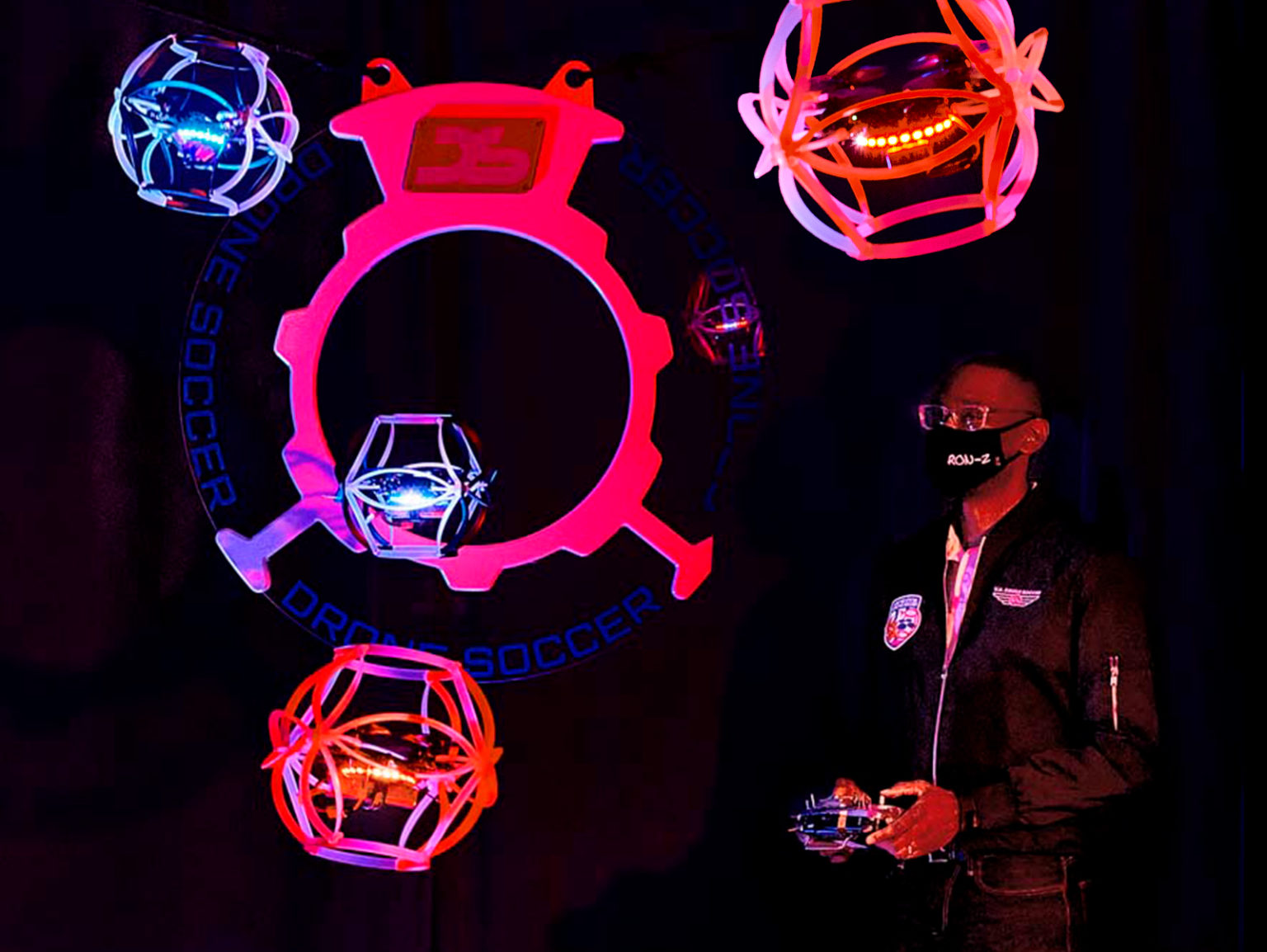
In drone soccer, roles are clearly defined before the match starts. Every drone is encased in a protective sphere, but they aren’t all equal in the eyes of the referee. The most critical player is the Striker. This is the only drone on your team allowed to score. You can identify the Striker by a specific light color or a flag attached to the drone’s exoskeleton.
- The Striker: Your team’s only offensive weapon. They must fly through the center of the opponent’s goal hoop to earn a point.
- The Defenders: The remaining four pilots act as shields. Their job is to physically block the opposing Striker or knock them off course using mid-air collisions.
- The Reset: After a goal is scored, the Striker must retreat to their own side of the field before they can attempt another scoring run.
The Three-Set Match Format


Matches are intense and physically demanding on the hardware. A standard competitive game consists of three sets. Each set lasts only three minutes. Because the drones operate at high RPMs and involve constant collisions, the short duration ensures the batteries don’t overheat and the pilots maintain peak focus. Between sets, teams have a short pit-stop period to swap out batteries, repair damaged exoskeletons, or tighten propellers. The team that wins two out of three sets is declared the winner.


Specialized Hardware: Spheres and High-Impact Drones


You cannot use a standard cinematic or racing drone for drone soccer. A typical drone would shatter upon the first collision. Instead, drone soccer utilizes “soccer drones”—specialized quadcopters encased in a 360-degree protective exoskeleton. These spheres allow the drones to bounce off walls, the floor, and each other without damaging the internal electronics or propellers.
The Protective Exoskeleton Design


The hallmark of a soccer drone is its spherical exoskeleton. Typically constructed from high-impact carbon fiber or durable plastic polymers, these cages serve two purposes. First, they protect the internal motors and flight controllers from the 30-40 mph impacts common during play. Second, they allow the drones to “roll” along the netting or floor, enabling a pilot to recover quickly after being knocked down. When you are defending your goal, you are essentially using this sphere as a physical shield to ram the opponent.


Official Size Classes: 20cm and 40cm


Competitive drone soccer is generally split into two primary size classes based on the diameter of the protective sphere. Choosing the right size depends on the age of the pilots and the level of sanctioned competition you are entering.
- 20cm Class: These are smaller, lighter, and typically used in youth leagues or indoor gymnasiums. They are agile and easier to repair, making them ideal for schools and STEM programs.
- 40cm Class: This is the professional standard used by the Federation of International Drone Soccer Association (FIDA). These drones are significantly heavier, faster, and much louder. They require more powerful brushless motors and higher-capacity LiPo batteries to maintain flight while carrying the weight of a larger carbon fiber cage.
- Full-Contact Durability: Both sizes are designed for “full contact,” meaning you are encouraged to hit other drones. The gear is built to be modular, so if a piece of the cage snaps, you can quickly bolt on a replacement part between sets.
By focusing on these specialized builds, the sport ensures that the focus remains on pilot skill rather than who has the most fragile, expensive equipment. Every drone on the field is essentially a flying tank, built to survive a three-minute whirlwind of high-velocity impact.
The Arena Layout and Scoring Dynamics


Unlike traditional drone racing, which takes place on open tracks, drone soccer is played inside a fully enclosed protective netting cage. This setup ensures the safety of spectators and players while allowing for intense, high-speed collisions. The arena is typically a rectangular space, with dimensions varying based on the class of drone being used—most commonly 20 feet by 40 feet for international competitions.

The Vertical “Donut” Goals
In drone soccer, you won’t find a net on the ground. Instead, the goals are circular hoops suspended vertically at each end of the arena. To score, the designated Striker drone must fly completely through the center of the opponent’s hoop. This creates a fascinating 3D playing field where players must manage altitude, pitch, and yaw simultaneously to hit a target that is often being guarded by a hovering wall of defenders.
Offensive and Defensive Roles
Each team consists of up to five pilots, but only one is the designated Striker (usually identified by a bright LED color or a physical ribbon). Only the Striker can score points. The other four pilots serve as “Blockers” or “Wingmen.” Their job is to physically knock the opposing Striker off course or create a protective formation around their own. Because the drones are encased in durable exoskeletons, “checking” an opponent in mid-air is not just allowed—it is a core strategy.



- The 3-Minute Sprint: Matches are incredibly fast, typically consisting of three sets lasting three minutes each.
- The Reset Rule: After a goal is scored, the scoring team must retreat to the midline before attacking again, preventing “spawn camping” at the goal.
- Full Contact: Physical interference is encouraged; a well-timed “bump” can send an opponent tumbling to the floor, forcing them to reboot.
Educational Impact and Professional League Growth


Beyond the adrenaline of the arena, drone soccer is rapidly becoming a cornerstone of STEM education. It bridges the gap between gaming and real-world engineering. Because these drones are built to be crashed, they are also built to be repaired. Students don’t just fly; they learn the mechanics of flight by maintaining their own equipment.
A Gateway to STEM and Aviation
Many schools and youth organizations have adopted drone soccer because it teaches high-value skills in an environment that feels like a varsity sport. Participants gain hands-on experience with soldering, electronics, aerodynamics, and radio frequencies. It is one of the few sports where “bench time” involves troubleshooting flight controller software or replacing a motor, providing a direct pipeline to careers in aerospace and robotics.
The Path to Professional Play
What started as a niche hobby in South Korea has exploded into a globally recognized sport. The World Air Sports Federation (FAI) now recognizes drone soccer as an official international air sport. We are seeing the rise of collegiate leagues and national championships across the United States, Europe, and Asia. This professionalization means better gear, standardized rules, and even scholarship opportunities for top-tier pilots.
- League Diversity: There are different classes for various age groups, from the small 20cm “Class 20” drones for beginners to the massive 40cm “Class 40” drones for professional play.
- Career Readiness: Participating in a league often counts toward drone pilot certification hours (such as the FAA Part 107 in the US).
- Global Community: Major events like the FAI World Cup draw teams from over 20 countries, fostering a massive international community of “drone-thusiasts.”
Conclusion
Drone soccer is far more than a high-tech game of keep-away. It is a thrilling fusion of competitive e-sports, physical contact, and advanced engineering. By combining the accessibility of a video game with the tactile satisfaction of building and flying real hardware, it offers something for everyone—from students looking for a future in tech to hobbyists seeking a new competitive outlet. Whether you are interested in the defensive strategy of a “Blocker” or the high-speed glory of a “Striker,” there has never been a better time to get involved.
To get started, look for a local drone soccer club in your area or explore starter kits to practice your hovering skills at home. The future of sports is flying—are you ready to take the pitch?
❓ Frequently Asked Questions
What are the two common drone sizes used in competition?
Matches usually feature either 20cm drones for youth/indoor play or 40cm drones for professional and international leagues. These sizes are standardized to ensure fair competition and uniform equipment specifications.
Do I need a special license to play drone soccer?
While casual play doesn’t require a license, professional leagues often require pilots to follow local aviation regulations (like FAA TRUST or Part 107 in the US). Most organized leagues provide insurance and safety training as part of membership.
Why is drone soccer considered a STEM activity?
It teaches students aerodynamics, electronics, and rapid repair skills, as drones must be maintained between sets. The competitive environment encourages problem-solving and engineering under pressure.
What is the ‘Striker’ and how do they score?
The Striker is the only drone on a team permitted to fly through the opponent’s goal hoop to score points. They are often identified by a specific LED color or a physical tag on the drone sphere.
What happens if a drone crashes during a set?
Players are encouraged to recover and relaunch if possible, but there are no timeouts for repairs during a three-minute set. Quick-repair skills are vital for teams to stay competitive between rounds.
Is the drone soccer arena dangerous for spectators?
No, drone soccer is played within a fully enclosed net or ‘cage’ that prevents drones from exiting the play area. This setup ensures the safety of the pilots, referees, and the audience.

Similar Posts