Anti Drone Gun: How It Works to Intercept and Neutralize UAVs
Commercial UAV Pilot & Aerial Cinematography Specialist at Drone Nestle · FAA Part 107 Remote Pilot Certification, Commercial UAS Operations · 10+ Years in Commercial UAV Operations, Flight Hardware Benchmarking & 4K Aerial Cinematography
An anti-drone gun works by emitting concentrated radio frequency (RF) signals that overpower the communication link between a drone and its operator. This process disrupts command-and-control (C2) and GPS signals, forcing the drone to enter a fail-safe mode, such as a controlled vertical landing or hovering in place.
🎯 Key Takeaways
- RF jamming floods drone receivers with noise to break operator command links.
- GPS/GNSS interference disorients the drone, preventing autonomous Return to Home functions.
- Interference with 2.4GHz and 5.8GHz bands severs the live video transmission feed.
- Neutralized drones typically perform a controlled vertical landing or hover until battery exhaustion.
- Directional antennas allow operators to target specific drones without affecting nearby civilian electronics.
An anti-drone gun works by overwhelming a drone’s communication channels with high-intensity electromagnetic energy. Instead of firing a physical projectile, it emits radio frequency (RF) interference on the exact bands the drone uses for control and data transmission. This process effectively severs the digital link between the pilot’s remote control and the aircraft, forcing the drone into a pre-programmed fail-safe state. Understanding these mechanics is vital for security professionals because it allows for the non-destructive neutralization of unauthorized UAVs.

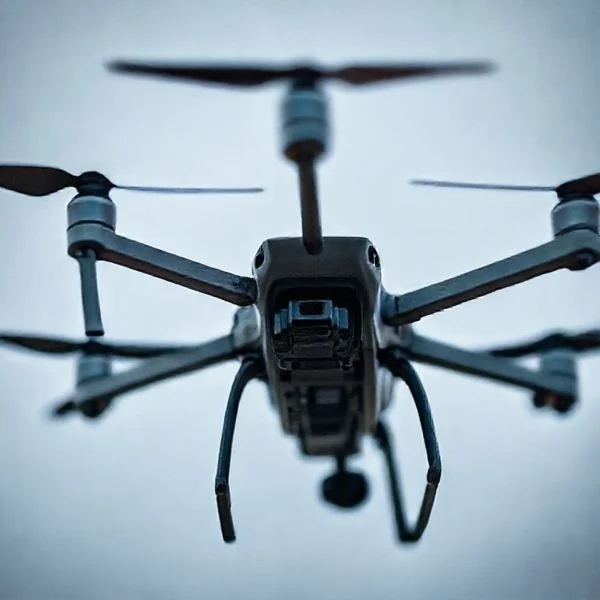
By targeting the electronic “brain” of the drone rather than its physical frame, you can stop a potential threat without causing collateral damage or creating dangerous falling debris. This “soft kill” approach ensures that the drone is either forced to land or return to its origin, providing a controlled end to a potentially hazardous situation.
Understanding RF Jamming: The Electronic Principles of Signal Disruption


The core of anti-drone technology is RF jamming. Most commercial and prosumer drones operate on two primary ISM (Industrial, Scientific, and Medical) bands: 2.4 GHz and 5.8 GHz. An anti-drone gun features a directional antenna that focuses a concentrated burst of electronic “noise” directly at the drone. This noise is a high-power radio signal that operates on the same frequency as the drone’s receiver. By flooding these frequencies, the device raises the “noise floor” to a point where the drone can no longer distinguish the pilot’s commands from the background interference.


Breaking the Command-and-Control (C2) Link
When the C2 link is broken, the drone loses its instructions. In most modern systems, this triggers a “link loss” protocol. Because the anti-drone gun is closer to the drone or emitting a significantly stronger signal than the remote controller, the drone’s receiver becomes electronically “deaf” to its owner. This disruption is achieved through several specific mechanisms:
- Frequency Matching: The jammer identifies the hopping pattern of the drone’s signal and matches it instantly to ensure constant interference.
- Signal Overpowering: The gun uses high-gain antennas to ensure the jamming signal reaches the drone with significantly more “volume” than the legitimate transmitter.
- Packet Disruption: It breaks the digital packet-based communication, which causes the drone’s onboard computer to enter an emergency hover or land-in-place mode.
Severing the Live Video Feed and Telemetry


Interfering with the video downlink is just as critical as stopping the control signals. Most operators rely on a First-Person View (FPV) to navigate the drone. By jamming the 5.8 GHz band, the anti-drone gun cuts off the operator’s visual perspective. Without a live feed, the pilot cannot adjust for obstacles or manually fly the drone back to safety. You effectively blind the threat while the C2 disruption takes hold, preventing the pilot from gathering intelligence or seeing their target. This dual-band disruption ensures the drone becomes an isolated object, disconnected from its human operator.

Navigation Interference: How GPS and GNSS Spoofing Disorients UAVs


Even if the control link is severed, many high-end drones use Global Navigation Satellite Systems (GNSS)—such as GPS, GLONASS, or Galileo—to fly autonomously or execute a “Return to Home” (RTH) function. An anti-drone gun targets these satellite signals to strip the drone of its spatial awareness. Satellite signals are notoriously weak by the time they reach Earth from orbit. This makes them incredibly easy to overwhelm with a handheld electronic device that is only a few hundred meters away from the target.
Jamming vs. Navigation Signal Masking


Most portable anti-drone guns focus on GNSS jamming rather than complex spoofing. Jamming simply blocks the satellite signal, causing the drone to lose its coordinates and orientation. When the drone can no longer see the satellites, its internal navigation system fails. This is a critical step in neutralizing “dark” drones that are flying on a pre-programmed GPS path without an active remote control link.


- Signal Masking: The gun emits a signal on the L1 and L2 GPS bands (roughly 1.2 GHz and 1.5 GHz) to hide the legitimate satellite data.
- Disabling RTH: Without a valid GPS lock, the drone cannot calculate the vector back to its launch point, preventing it from escaping the area.
- Drift Induction: Without satellite stabilization, the drone loses the ability to fight wind drift or maintain a steady hover, making it easier to force the aircraft into a controlled descent.
- Controlled Landing: Most drones are programmed to land slowly if they lose both the pilot’s signal and their GPS coordinates simultaneously, ensuring the drone is neutralized safely on the ground rather than falling from the sky.
By combining RF jamming with navigation interference, the anti-drone gun creates an electronic “bubble” that the drone cannot communicate through. This multi-layered approach ensures that whether the drone is being flown manually or following a GPS track, it is forced to stop its mission immediately. The result is a neutralized UAV that can be recovered and analyzed for forensic evidence.
Drone Behavior Analysis: Fail-Safe Responses to Signal Loss


When an anti-drone gun floods a UAV with interference, the drone doesn’t typically “fall out of the sky” like a bird hit by a projectile. Instead, the onboard flight controller triggers pre-programmed fail-safe protocols. These responses are designed by manufacturers to prevent the drone from becoming a dangerous uncontrolled object once it loses its connection to the pilot.

Return-to-Home (RTH) vs. Immediate Landing


Most modern consumer and commercial drones are programmed with a “Return-to-Home” feature. If the anti-drone gun targets only the command and control frequency (2.4GHz or 5.8GHz) but leaves the GPS signal intact, the drone will often turn around and fly back to its original takeoff point. However, if the jammer also blocks GNSS (GPS) signals, the drone becomes “blind.” In this scenario, most drones are programmed to perform a controlled vertical descent, landing slowly and safely exactly where they are currently hovering.
Disruption of Live Telemetry and Video
Beyond physical movement, the anti-drone gun effectively severs the digital “umbilical cord” between the aircraft and the operator. This results in several immediate effects:
- Blackout: The operator’s screen goes black or freezes, removing their ability to see through the drone’s camera.
- Loss of Telemetry: Real-time data regarding altitude, battery life, and speed is lost, leaving the pilot unable to troubleshoot the issue.
- Hovering State: Many high-end drones will enter a “position hold” mode for several seconds, trying to re-establish a connection before initiating a landing or RTH sequence.
Practical Tip: Security teams often prefer “GPS spoofing” or blocking to force an immediate landing, as this allows for the physical recovery of the drone for forensic analysis.


Technical Specifications: Targeted Frequencies and Effective Range Factors


The effectiveness of an anti-drone gun depends heavily on its internal hardware and the environment in which it is used. These devices are not “one size fits all”; they are precision instruments tuned to the specific radio frequency (RF) bands used by the majority of UAV manufacturers worldwide.
The Radio Frequency Spectrum
Most anti-drone guns operate across multiple bands simultaneously to ensure the target is neutralized regardless of the channel it is using. The most common targeted frequencies include:
- 2.4 GHz: The standard frequency for most consumer-grade remote controls and Wi-Fi-based drones.
- 5.8 GHz: A higher frequency often used for long-range video transmission and high-speed racing drones.
- GNSS (L1/L2): The satellite bands (GPS, GLONASS, Galileo) used for navigation and stabilization.
- 433 MHz / 915 MHz: Frequencies often utilized by long-range industrial drones or DIY hobbyist kits.
Factors Affecting Operational Distance
While some manufacturers claim a range of up to 2 kilometers, the effective range in a real-world scenario can vary. The distance at which you can successfully “drop” a drone depends on the signal-to-noise ratio. For example, if a drone is very close to its pilot, the pilot’s signal is stronger, making it harder for the anti-drone gun to “overpower” it from a distance.
Other critical factors include:
- Line of Sight (LoS): Physical obstructions like buildings, thick foliage, or hills can significantly weaken the jamming signal.
- Battery Output: The power level of the jammer’s battery determines the “loudness” of the interference signal.
- Antenna Gain: High-gain directional antennas allow the gun to focus its energy on a specific point in the sky rather than scattering it.
Security Example: In a dense urban environment with heavy Wi-Fi interference, the effective range of an anti-drone gun might be reduced by 30-50% compared to an open rural field.
Conclusion
Anti-drone guns represent a sophisticated, non-kinetic solution to the growing challenge of unauthorized UAVs. By understanding how these devices disrupt specific radio frequencies and trigger drone fail-safes, security professionals can effectively protect sensitive airspace without causing collateral damage. Whether through forcing a controlled landing or triggering a Return-to-Home protocol, these tools provide a critical layer of modern defense.
Next Steps: If you are considering an anti-drone solution, start by auditing your local airspace to identify the most common drone types present. Then, research the legal regulations regarding RF jamming in your specific jurisdiction, as these devices are often restricted to government or law enforcement use. Stay vigilant and keep your security protocols updated as UAV technology continues to evolve!
❓ Frequently Asked Questions
What is the primary difference between RF jamming and GPS spoofing?
RF jamming floods the drone’s communication channel with noise to block instructions, while spoofing sends fake GPS coordinates to trick the drone’s navigation system into thinking it is elsewhere.
Why don’t drones just fall out of the sky when hit by a jammer?
Most modern drones have fail-safe software that triggers a controlled descent or hover when they lose contact with the controller to prevent a dangerous crash.
Can an anti-drone gun work on autonomous drones that don’t use RF?
If the drone relies on pre-programmed GPS waypoints, GPS jamming can still disorient it; however, drones using pure optical navigation are much harder to stop with RF jammers.
How do directional antennas improve the device’s effectiveness?
Directional antennas concentrate electromagnetic energy into a narrow beam, which increases the effective range and power density directed at the target drone.
Are there specific power requirements for these devices?
High-output power is required to overcome the signal from the drone’s original transmitter, necessitating high-capacity battery systems within the handheld unit.
Does the weather affect how an anti-drone gun operates?
While RF signals can penetrate most weather, heavy rain or dense fog can slightly attenuate the signal, reducing the maximum effective range of the jamming beam.

Similar Posts