Best 3D Printers for Drone Parts: TPU & Carbon Fiber Guide
Commercial UAV Pilot & Aerial Cinematography Specialist at Drone Nestle · FAA Part 107 Remote Pilot Certification, Commercial UAS Operations · 10+ Years in Commercial UAV Operations, Flight Hardware Benchmarking & 4K Aerial Cinematography
The best 3D printers for drone parts must feature direct drive extruders to handle flexible TPU and high-temperature nozzles for rugged Carbon Fiber filaments. Prioritizing dimensional accuracy is essential to ensure that motor mounts and flight controllers fit perfectly within your frame.
🎯 Key Takeaways
- Direct drive extruders are mandatory for reliable TPU drone mount printing.
- A 300°C nozzle is required for high-strength Carbon Fiber and Nylon parts.
- CoreXY printer architectures offer the best precision for tight component fitment.
- Enclosed build volumes prevent warping in structural Polycarbonate or Nylon frames.
- PEI spring steel sheets provide the best balance of adhesion and easy removal.
To print drone parts that survive high-speed impacts and harsh flight conditions, you need a printer capable of handling TPU (Thermoplastic Polyurethane) and Carbon Fiber-filled filaments. The “best” printer for a drone pilot isn’t the one that makes the prettiest statues; it is the one with a Direct Drive extruder and a hardened high-temperature nozzle. These two features determine whether your GoPro mount peels off in mid-air or your frame arms snap on the first gate clip.
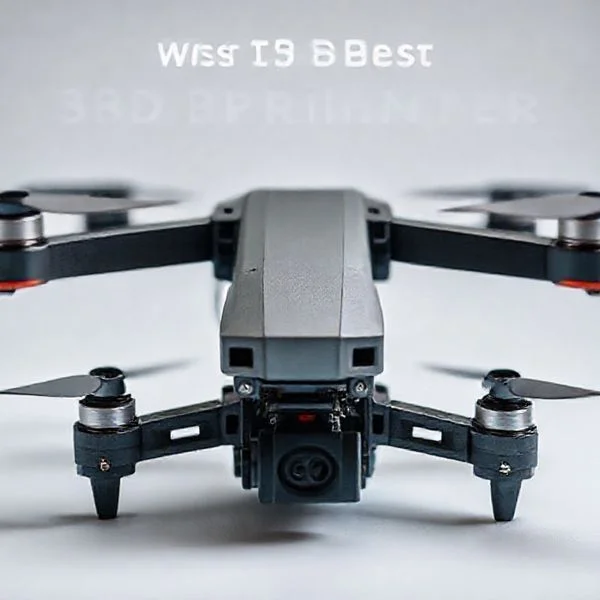
Choosing the right machine directly impacts your flight time and repair costs. A printer with poor tolerances results in motor mounts that don’t align or flight controller stacks that won’t sit flush. By prioritizing hardware that manages flexible and abrasive materials, you ensure that every part you print—from skid plates to antenna mounts—is flight-ready and structurally sound.
Critical Features: Why Direct Drive and High-Temp Nozzles Matter for Drones


The Direct Drive Mandate for TPU Accessories


If you are printing FPV camera mounts, arm protectors, or antenna tubes, you are likely using TPU. This material is notoriously flexible and difficult to extrude. Most entry-level printers use a Bowden tube system, where the motor pushes filament through a long PTFE tube. For drones, this is a recipe for failure. TPU behaves like wet spaghetti; in a Bowden setup, it bunches up, clogs, and creates massive stringing that ruins the aerodynamics and fitment of your parts.

- Short Filament Path: Direct Drive extruders sit directly above the hotend. This minimizes the distance the filament travels, allowing for precise control over retraction.
- Reduced Stringing: Better retraction means your TPU mounts won’t have “hairs” that interfere with camera lenses or motor bells.
- Consistent Extrusion: You get uniform wall thickness, which is vital for the structural integrity of thin-walled drone accessories.
High-Temp Hardened Nozzles for Carbon Fiber Parts


While TPU provides the “bounce,” Carbon Fiber Nylon (PA-CF) or CF-Polycarbonate provides the “bone.” These materials require nozzle temperatures between 280°C and 300°C. Standard brass nozzles will melt or fail to reach these temps. Furthermore, carbon fiber is highly abrasive. A standard brass nozzle will be destroyed after half a roll of CF filament, widening the bore and ruining your printer’s precision. For drone frames or stiffeners, you must have a hardened steel or tungsten carbide nozzle paired with an all-metal hotend.
Top-Rated 3D Printers for FPV Frames and TPU Accessories


Bambu Lab P1S: The Current Industry Standard


The Bambu Lab P1S has quickly become the favorite for drone builders because it solves the two biggest hurdles: speed and enclosure. Carbon fiber-reinforced filaments are prone to warping if they cool too quickly. The P1S features a fully enclosed chamber that maintains a steady ambient temperature, ensuring your custom 5-inch frames stay perfectly flat. Its Direct Drive system is exceptionally well-tuned for 95A and 98A TPU, which are the gold standards for drone durability.
- Active Vibration Compensation: This ensures that even at high speeds, the tolerances for your 20×20 or 30×30 mounting holes remain perfect.
- Hardened Gear Upgrade: While you may need to swap the nozzle to hardened steel, the internal drive gears are robust enough for continuous CF printing.
- Plug-and-Play TPU: The pre-configured profiles for flexible materials reduce the trial-and-error often associated with custom drone parts.
Prusa MK4: Precision for Tight Tolerances



When you are building a micro-quad or a “whoop,” every millimeter matters. The Prusa MK4 is renowned for its Nextruder, a direct drive system that uses a load-cell sensor for a perfect first layer every time. For drone pilots, this means your motor mounts will have the exact thickness required for your M2 or M3 screws. There is no guesswork involved in “Z-offset,” which is often where part fitment issues begin.
- Exceptional Reliability: You can start a 10-hour print of a full racing frame and trust that the dimensions will be accurate to within 0.1mm.
- Open Ecosystem: Prusa allows you to swap nozzles easily, making it simple to switch between a 0.4mm nozzle for detailed TPU prints and a 0.6mm hardened nozzle for rugged CF-Nylon parts.
- Input Shaper Support: This firmware feature eliminates “ghosting” on the vertical walls of your mounts, ensuring your flight controller stack fits perfectly inside the printed pod.
Material Compatibility: Evaluating Printers for Carbon Fiber, Nylon, and PC
While flexible TPU is excellent for protective bumpers, the best 3D printer for drone parts must also handle high-performance engineering plastics. Carbon Fiber reinforced Nylon (PA-CF) and Polycarbonate (PC) are the gold standards for drone frames and motor mounts because they offer extreme stiffness and heat resistance. However, these materials are demanding and require specific hardware features that standard budget printers often lack.

High-Temperature Extruders and Hardened Nozzles
To print drone-grade composites, your printer needs an all-metal hotend capable of reaching at least 280°C to 300°C. Standard brass nozzles will deteriorate rapidly when abrasive carbon fibers rub against them. When shopping for a printer, look for models that come stock with—or easily support—hardened steel or tungsten carbide nozzles to maintain diameter consistency over time.
- Direct Drive Advantage: Direct drive extruders are generally superior for these filaments, providing the consistent torque needed to push thick, fiber-filled materials through the nozzle.
- Practical Example: A Carbon Fiber Nylon frame arm is significantly stiffer than one made from PLA or PETG, effectively eliminating “prop wash” oscillations during high-speed maneuvers.
The Importance of Enclosures for Structural Filaments
Nylon and Polycarbonate are notorious for warping and shrinking as they cool. A printer with a dedicated enclosure, such as the Bambu Lab P1S or the Creality K1, traps ambient heat to ensure the part cools slowly and evenly. Without a stable thermal environment, large drone parts may lift off the build plate or suffer from layer delamination, which can lead to a mid-air structural failure.
Accuracy and Fitment: Achieving Tight Tolerances for Electronics Mounting


In the DIY drone world, every millimeter counts. You aren’t just printing aesthetic shells; you are creating housings for sensitive flight controllers, tiny camera lenses, and precision-milled motors. The best 3D printer for drone parts must offer exceptional dimensional accuracy to ensure that every component “snaps” into place without the need for messy post-processing.
Bed Leveling and First-Layer Consistency
If your first layer isn’t perfectly flat, your motor mounts will be tilted. This slight misalignment causes vibrations that can confuse your flight controller’s gyroscope, leading to poor flight performance. Modern printers with high-density Auto Bed Leveling (ABL) sensors are essential. They create a digital map of the build surface and adjust the Z-height in real-time, guaranteeing a perfectly level base for your drone builds.
Dimensional Accuracy and Shrinkage Compensation
Materials like Nylon can shrink by up to 1-2% as they cool. High-end printers and slicer profiles allow for fine-tuned calibration of “steps per millimeter” and flow rates. This ensures that a 20mm mounting hole actually measures 20mm once the print is finished. Consistency across the X and Y axes is what separates a hobbyist machine from a professional drone-building tool.
- Key Tip: Look for printers with “Input Shaping” or “Vibration Compensation.” This technology allows for fast printing while maintaining sharp corners and preventing “ringing” around screw holes.
- Real-world Example: A well-calibrated printer allows a 30x30mm flight stack to slide onto printed TPU standoffs with zero friction, protecting the electronics from vibration while keeping them securely centered.
Final Thoughts on Choosing Your Drone Printer
Choosing the best 3D printer for drone parts is about balancing material versatility with mechanical precision. For most pilots, a machine that handles both flexible TPU and rigid, fiber-reinforced nylon is the ultimate workshop companion. By prioritizing a high-temperature hotend, an enclosed build volume, and reliable auto-leveling, you ensure your custom builds are as durable as they are fast. Your next step is to pick a machine that fits your budget, calibrate it for your favorite high-strength filament, and start testing your designs. Clear skies and happy flying!
❓ Frequently Asked Questions
Why is a direct drive extruder non-negotiable for drone pilots?
Drone parts rely heavily on TPU (Thermoplastic Polyurethane) for vibration dampening and crash protection. Direct drive extruders push this soft, flexible filament directly into the nozzle, preventing the jamming, clogging, and buckling common in Bowden tube systems.
What nozzle temperature capability should I look for in a drone-focused 3D printer?
You should look for a printer with an all-metal hotend capable of reaching at least 300°C. This temperature range is necessary to print advanced materials like Carbon Fiber-filled Nylon (PA-CF), which is the gold standard for ultra-durable, lightweight drone components.
How do I ensure my 3D printed motor mounts fit perfectly?
Precision is key; look for printers with high motion stability, such as those using linear rails or CoreXY designs. Calibrating your printer’s flow rate and E-steps is essential to ensure that M3 screw holes and stack mounts align within 0.1mm tolerances.
Are resin (SLA) printers suitable for manufacturing drone components?
Generally, no; standard resin is too brittle and will shatter upon the high-velocity impacts common in drone racing or freestyle. While some engineering-grade resins exist, FDM (filament) printing remains superior for its impact resistance and material variety.
What build volume is required for most drone-related projects?
A standard build plate of 220x220mm is more than sufficient for 5-inch FPV frames and accessories. You only need a larger build volume (300mm+) if you intend to print large X-class frames or fixed-wing UAV components in a single piece.
Does the printer speed matter when manufacturing drone parts?
While high-speed printers like the Bambu Lab P1S save time, layer adhesion is more important for drone durability. You must ensure that even at high speeds, the printer maintains enough heat and cooling control to prevent the layers from splitting during a crash.



Similar Posts